
Outcome of the Review
The Design Efficiency Review has confirmed that the Bridgwater Tidal Barrier Scheme will continue to deliver the same level of flood protection (1 in 200-year event) via a simplified, more functional, and updated design for more cost efficiency during and after it is built.
The review was necessary in:
- Responding to inflation and global market pressures in materials, energy, and labour.
- Ensuring continued responsible use of public funds.
- Delivering the Scheme in a way that remains achievable and sustainable.
- Reviewing newer technology and how we can achieve the same with less.
- Reducing operational and maintenance costs longer term.
The review has concluded to date that:
- The Scheme will progress with a simplified superstructure design.
- A refined and more functional design that while it reduces architectural features maintains full flood protection.
- Substructure and downstream defence work continue as planned.
- Value for money and continuity remain central – optimising cost, programme and spend.
The revised concept design brings a cleaner, more efficient form. With key refinements to include:
- A 10 metre reduction in overall height, the three towers will be approximately 15 metres high.
- Streamlined, more uniform tower shapes with simplified mechanical systems.
- Relocation of drive equipment (that moves the barrier gates) to the base of the towers, making easier and safer access for maintenance, while reducing long-term operating costs.
- Lighter, high level, operational walkways in place of the former overbridge, providing operational access between the towers.
These changes reduce construction complexity, cost, and embodied carbon while ensuring the same high performance and safety standards are met.
This approach ensures the structure remains iconic to Bridgwater, while being more sustainable, cost-effective, and easier to maintain over its lifetime.
The image we can share now is the outline design for the Bridgwater Tidal Barrier.
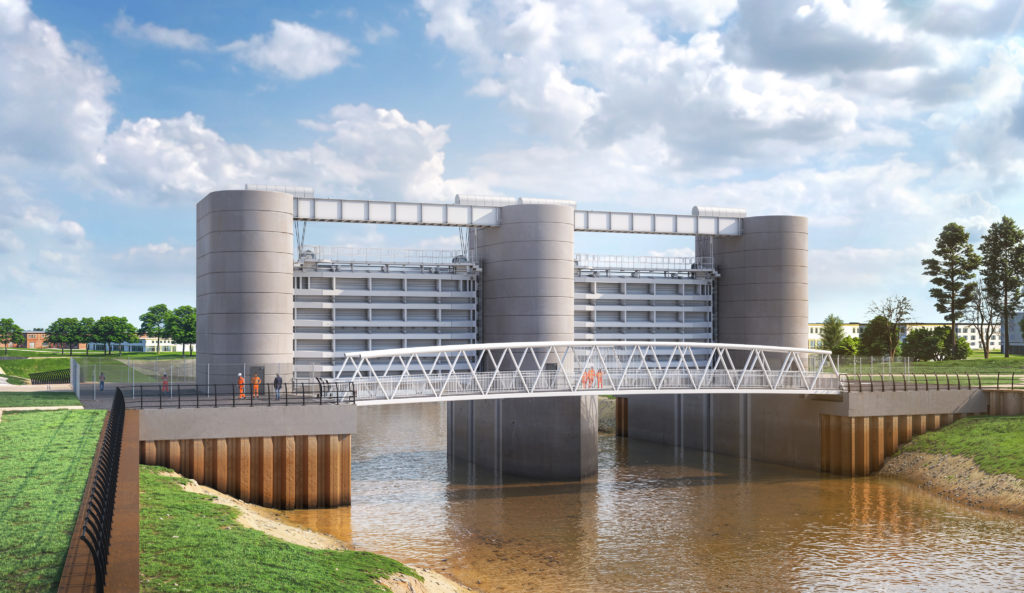
The design will continue to be refined from the current outline design, to the final detailed design for the barrier which is due to be completed in mid-2026. As the project develops, we are committed to sharing updates to show how the design is evolving and how feedback has informed the process.
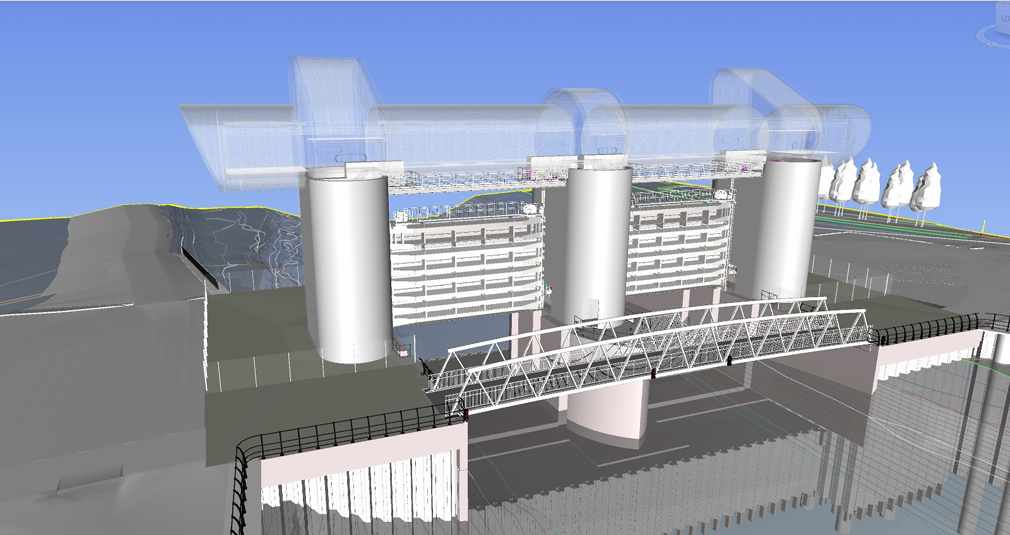
An image overlaying the previous design of the barrier with the new concept design.
Programme Delivery and Transport and Works Act Order (TWAO)
The BTB Scheme remains fully compliant with its Transport and Works Act Order and environmental commitments, and the project continues to work closely with Somerset Council and delivery partners.
The Design Efficiency Review marks an important milestone, but it reflects an approach embedded across the Scheme: continuous improvement and value engineering. Across the wider programme, the team is refining designs to improve constructability and efficiency without compromising safety, quality or performance.
This includes efficiencies already delivered within the downstream defences, where refinements to embankment design have reduced cost and construction time while maintaining the same height and standard of flood protection. Together, these changes ensure the Scheme remains resilient, efficient and fit for the long term.
Cost
Value for money underpins every decision on the BTB Scheme, with all changes progressed through established governance processes and in line with commitments to responsible public investment.
The review has identified cost increase mitigation through design simplification, material efficiencies and optimising construction. This ensures public investment continues to deliver maximum benefit in flood risk reduction, resilience and long-term community value.
The review is ongoing, with further refinement underway in areas such as the operational building and landscape design. Once finalised, the project will publish an updated position on programme.
The BTB Scheme continues to receive strong support from central government, Defra and the Environment Agency. Full approval of the business case in September 2024 secured eligibility for Flood Defence Grant-in-Aid funding, with significant capital allocations already confirmed as part of the current national programme.
Funding for the Bridgwater Tidal Barrier Scheme comes from a partnership of national, regional and local sources, reflecting the Scheme’s importance for flood risk reduction, economic growth and national resilience. These include:
- Defra (Flood Defence Grant-in-Aid and Other Government Department contributions)
- Environment Agency
- Somerset Council (via Community infrastructure Levy, S106 and Town Deal Funding)
- Heart of the South West LEP
- Wessex Regional Flood and Coastal Committee (Local Levy)
Other contributors are the Somerset Rivers Authority (SRA) Department for Education (DfE), and the Wildfowl and Wetlands Trust (WWT).
This model reflects the significance of the Scheme for local communities, the regional economy and national resilience.
Continuity, value and legacy
Enabling construction work started in 2023, substructure works and downstream defences have moved forward well too with significant progress made on site in 2025. There is an ambition to ensure the design review integrates into the live programme as we move into 2026 and continues to run alongside, incorporating the agreed design changes where required to avoid unnecessary delay.
The project is also delivering additional environmental, social and economic benefits, including reducing embodied carbon, enhancing habitats and biodiversity, restoring historic kilns for public display, and improving cycle and footpath connections.
Key benefits
This is a nationally significant investment in Bridgwater’s future. The cost reflects the scale and importance of the protection it provides, safeguarding homes, businesses, schools, and vital transport links from tidal flooding.
The benefits go far beyond immediate flood risk reduction: the scheme unlocks future growth, supports new housing and jobs, enhances biodiversity, and strengthens climate resilience for generations to come.
The review ensures we achieve those same outcomes in the most cost-efficient way possible, achieving long-term value, not just short-term savings.
- 12,800 homes and businesses safeguarded.
- Enabling local economic growth and new housing.
- Environmental enhancements: improved habitats, biodiversity links, partnership with WWT and Blue Heritage.
- Community legacy: riverside park and active travel connections.
Engagement
We know change brings questions. We are committed to transparency, regular updates, and two-way engagement as the design changes for the BTB Scheme progress.
The BTB Scheme hosted public drop in sessions to show recent progress of the Scheme and outcomes in relation to the Design Efficiency Review.
Moving forward stakeholders will continue to receive tailored briefings as design details evolve. Public updates will be shared through website, community newsletters, social media, and future drop-in sessions. We will keep communication flowing even while some details are still being finalised.
Resources from drop in sessions

Questions and answers
What exactly has the Design Efficiency Review decided?
The Design Efficiency Review has optimised the Bridgwater Tidal Barrier (BTB) Scheme design to realise savings through design simplification, material efficiencies, and construction optimisation, ensuring that public investment continues to deliver the greatest possible return in terms of flood risk reduction, resilience, and community benefit.
Is the scheme still going ahead?
The BTB Scheme continues with an active construction programme and remains a priority for Government, the Environment Agency and Somerset Council. The recent Design Efficiency Review is about ensuring best value for money, not cutting back on the essential flood risk reduction the barrier will provide.
The core purpose of the Scheme, protecting 12,800 homes, businesses, and vital infrastructure from tidal flooding is unchanged. What has changed is the design of the barrier superstructure: it will now be delivered in a simpler, more functional, and more cost-efficient form. This ensures we still achieve the same level of flood risk reduction while ensuring the Scheme is affordable and sustainable for the long term.
Construction of the barrier substructure and downstream defences is already underway, and progress will continue while the updated design is incorporated.
Why is the design of the barrier changing?
The design changes simplify the structure to make it more efficient and cost-effective, while still providing the same level of flood risk reduction for Bridgwater and surrounding communities.
Why wasn’t a more pared-back look agreed in the first place?
The original tidal barrier design was right for its time. It reflected the best available information, priorities, and affordability context when the project began. As the project has progressed and evolved and market conditions changed, it was both responsible and necessary to review and refine it.
The revised design still has a strong architectural identity; three sculptural towers, a clean, functional form, and visibility as a landmark, but it’s more in keeping with the landscape, will mean less embodied carbon (refers to all the carbon emissions involved in producing and constructing the barrier) and be simpler to maintain and build.
How does the design changes affect the level of protection?
The level of protection for the BTB Scheme remains the same providing a 1:200 year level of service and still protecting 12,800 homes and businesses. This means there is a 0.5% (1 in 200) chance in any given year of a tidal flood event that exceeds the level the Scheme is designed to protect against.
This level of protection will extend to 2125 for Bridgwater and 2055 for the downstream communities of Combwich, Chilton Trinity and Pawlett, reflecting differing flood risk profiles and the role of downstream defences within the wider flood risk system. and still protecting 12,800 homes and businesses.
What elements of the original design are being removed or changed?
The revised concept design brings a cleaner, more efficient form; three sculptural towers supporting two vertical lift gates across the River Parrett. The design change still responds to the surrounding landscape and retains a strong architectural identity while expressing functional engineering.
Key refinements include:
- A 10 metre reduction in overall height, making sure the structure still responds to the surrounding landscape.
- Streamlined, more uniform tower shapes with simplified mechanical systems.
- Relocation of drive equipment (that moves the barrier gates) to the base of the towers, making easier and safer access for maintenance, while reducing long-term operating costs.
- Lighter, high level, operational walkways in place of the former overbridge, providing operational access between the towers.
- The walk and cycle bridge across the river is still included.
These changes reduce construction complexity, cost, and embodied carbon while ensuring the same high performance and safety standards are met.
Do the design changes following the Design Efficiency Review require planning permission?
The Bridgwater Tidal Barrier is covered by a Transport and Works Act Order (TWAO) and planning direction from 2022. These approvals allow flexibility for changes like this without needing a new planning application.
Why was a review necessary now?
To ensure the Bridgwater Tidal Barrier Scheme remains both sustainable and affordable, it was essential to test assumptions, review design choices, and confirm that every stage of delivery continues to represent best value for money.
How do we know the revised scheme is still value for money?
Like all major infrastructure projects, the Scheme has been affected by wider market conditions. Significant inflationary pressures in materials, energy, and labour have driven up costs across the construction industry. By undertaking a structured Design Efficiency Review, the project has taken proactive steps to manage these pressures responsibly and maintain momentum.
The review has achieved cost increase mitigation through design simplification, material efficiencies, and construction optimisation, ensuring that public investment continues to deliver the greatest possible return in terms of flood protection, resilience, and community benefit.
These efficiencies have been realised while maintaining flood risk reduction and the Scheme’s resilience measures.
When will construction finish now?
Enabling construction work started in 2023, substructure works and downstream defences have moved forward well too with significant progress made on site in 2025. We will be on site for another 5 to 6 years. This timescale includes additional landscaping elements that are part of the wider design of the Scheme. The priority is to make the barrier operational so flood protection is available to Bridgwater and the surrounding areas as soon as possible.
What has changed in the sequencing of works?
Enabling construction work started in 2023, substructure works and downstream defences have moved forward well too with significant progress made on site in 2025. There is an ambition to ensure the design review integrates into the live programme as we move into 2026 and continues to run alongside, incorporating the agreed design changes where required to avoid unnecessary delay.